Toolkit guide
Topic
Promising practice — long-term (12-year) relational mentoring, sport-based engagement, equity focus on children at risk of social exclusion, cross-sectoral, cost-effective.
Tools & Frameworks
Good practice
Language
EN
Use it to…
Use it to help identify, adapt, and apply effective solutions for long-term, relationship-based support that reaches children at risk of social exclusion.
Where to look in this resource
The whole page is relevant - it summarises the main characteristics of the practice.
Setting
Area
2.2
Description

Founded in Finland in 1996, Icehearts forms teams of around 20 children identified early (around age 6) by pre-school, school and social services as needing special support. A full-time mentor stays with the same team for 12 years, until around age 18, using team sport as the entry point while supporting children at school, during leisure time, individually and through their families, in collaboration with other services. It is rooted in a salutogenic, rights-based approach, and is being piloted in other European countries through the Icehearts Europe project.

Brief description
12-year, sport-based mentoring programme for children at risk of social exclusion (Finland).
Country
Finland (origin); pilots in Denmark, Estonia, Italy, Slovenia, Spain
Keywords
mentoring, team sport, long-term support, social exclusion, family support, Targeted prevention, Promotion, cost-effectiveness

Resource Title
Icehearts
Source
WHO
Topic
stigma
Tools & Frameworks
Toolkit
Language
EN
Relevant actions
Layer 1
Use it to…
Support the design of scalable, system-level strategies to reduce stigma and discrimination, a key barrier to access, equity, and effectiveness in mental health systems.
Where to look in this resource
The whole document is relevant, as it sets out a four-step, evidence-based process — built on lived-experience leadership, social contact, and inclusive collaboration — for planning, delivering, and evaluating anti-stigma initiatives across health, workplace, school, and community settings.
Image
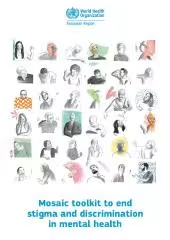
Mosaic toolkit to end stigma and discrimination in mental health
Age group
Setting
Area
2.2
Description

A structured and evidence-informed approach to reducing stigma and discrimination associated with mental health conditions. It is grounded in three core principles—leadership by people with lived experience, social contact, and inclusive collaboration—and translates these into a practical four-step process for designing, implementing, and scaling anti-stigma interventions. The toolkit combines conceptual guidance with actionable steps and real-world case studies, enabling adaptation across different policy, service, and community contexts. It also highlights the systemic nature of stigma, including its impact on access to care, social inclusion, and life opportunities, and emphasises the role of coordinated, multisectoral action in addressing these challenge

Brief description
Provides practical, evidence-based guidance for designing and implementing interventions to reduce stigma and discrimination in mental health.
Country
INTERNATIONAL
Keywords
stigma, discrimination, lived experience leadership, social contact, four-step process
Resource Title
Mosaic toolkit to end stigma and discrimination in mental health
Topic
Promising practice — cross-sectoral integration (health, social care, education) within one service point.
Tools & Frameworks
Good practice
Language
EN
Use it to…
Use it to help identify, adapt, and apply effective solutions for integrated 'one-stop' early years family support hubs.
Where to look in this resource
The whole document is relevant - it summarises the main characteristics of the practice.
Image
Family Centres
Area
2.2
Description

Following a Swedish model, Family Centres bring maternity and child health care, social-welfare services and early-education facilities together within a single, community-based service point for parents and young children. They are implemented across the Nordic countries (Sweden, Norway, Finland, Iceland, Denmark) and provide integrated, easily accessible support during the early years.

Brief description
Community-based hubs integrating health, social care and education for parents and young children.
Country
Denmark, Finland, Iceland, Norway, Sweden 
Keywords
Nordic model, integrated services, one-stop hub, early years, cross-sectoral, Promotion, Universal prevention
Resource Title
Family Centres
Topic
Promising practice - equity/marginalised-group focus, intersectoral (justice, welfare, social care), strengths-based.
Tools & Frameworks
Good practice
Language
EN
Use it to…
Use it to help identify, adapt, and apply effective solutions for cross-sector advocacy support for vulnerable young people and families.
Where to look in this resource
The whole document is relevant - it summarises the main characteristics of the practice.
Image
35_youth advocate
Area
2.2
Description

YAP provides intensive, strengths-based, person-centred support to young people and families involved in justice, welfare and social systems, working in the young person's own environment.

Brief description
Intensive, strengths-based advocacy support for at-risk young people and families.
Country
Ireland 
Keywords
strengths-based, justice, marginalised groups, Ireland, Family-based · Targeted prevention, At-risk young people & families, welfare, social
Resource Title
Youth Advocate Programme (YAP) Ireland
Topic
Promising practice — low-threshold access, peer/youth involvement, hybrid delivery, addresses stigma.
Tools & Frameworks
Good practice
Language
EN
Use it to…
Use it to help identify, adapt, and apply effective solutions for low-threshold, peer-supported walk-in mental health services.
Where to look in this resource
The whole document is relevant - it summarises the main characteristics of the practice.
Image
@ease
Setting
Area
2.2
Description

A low-threshold service offering free, anonymous support to young people in person and online, staffed by professionals and trained young volunteers. Young people participate both as beneficiaries and as peer providers.

Brief description
Low-threshold youth walk-in/online support (Netherlands).
Country
Netherlands 
Keywords
low-threshold, peer/youth involvement, hybrid delivery, stigma reduction
Resource Title
@ease
Topic
Promising practice - transferable service model, policy-embedded, youth participation, low-threshold.
Tools & Frameworks
Good practice
Language
EN
Use it to…
Use it to help identify, adapt, and apply effective solutions for cross-national transfer of low-threshold youth mental health centres.
Where to look in this resource
The whole document is relevant - it summarises the main characteristics of the practice.
Image
headspace (Denmark)
Setting
Area
2.2
Description

Adapted in Denmark from the Australian model, headspace offers free, low-threshold early support to young people through centres and online, staffed by professionals and trained young volunteers, with a dedicated Youth Council. A publicly available implementation guide supports replication.

Brief description
Low-threshold youth mental health centres (adapted from Australia).
Country
Denmark 
Keywords
transferable service model, policy-embedded, youth participation, low-threshold,
Resource Title
headspace (Denmark)
Topic
Promising practice - full-continuum integrated model, low-threshold, addresses fragmentation.
Tools & Frameworks
Good practice
Language
EN
Use it to…
Use it to help identify, adapt, and apply effective solutions for integrated, one-stop adolescent health and support centres.
Where to look in this resource
The whole document is relevant - it summarises the main characteristics of the practice.
Image
Maisons des Adolescents
Setting
Area
2.2
Description

A national network of multidisciplinary centres offering young people accessible support across the full continuum - from information and brief counselling to clinical care - bringing together health, social care and other services in one place.

Brief description
Multidisciplinary one-stop adolescent health/support centres (France).
Country
France 
Keywords
full-continuum, integrated model, addresses fragmentation, France-origin
Resource Title
Maisons des Adolescents
Topic
Promising practice - policy-embedded, low-threshold, equity and LGBTQIA+ responsiveness.
Tools & Frameworks
Good practice
Language
EN
Use it to…
Use it to help identify, adapt, and apply effective solutions for policy-embedded, equity-responsive national youth mental health services.
Where to look in this resource
The whole document is relevant - it summarises the main characteristics of the practice.
Image
Jigsaw
Setting
Area
2.2
Description

Ireland's national youth mental health service provides accessible, non-stigmatising support with minimal barriers to entry and online/hybrid options, and (with Belong To) has developed resources to support LGBTI+ young people. It is embedded within multiple overlapping national policy frameworks.

Brief description
National youth mental health service (Ireland).
Country
Ireland 
Keywords
low-threshold, equity, LGBTQIA+ responsive, policy-embedded, Ireland
Pdf file
67_Jigsaw.pdf (235.47 KB)
Resource Title
Jigsaw
Topic
Promising practice - integrated multidisciplinary model, addresses fragmentation, intersectoral.
Tools & Frameworks
Good practice
Language
EN
Use it to…
Use it to help identify, adapt, and apply effective solutions for flexible, community-based treatment for young people with complex needs.
Where to look in this resource
The whole document is relevant - it summarises the main characteristics of the practice.
Image
Flexible Assertive Community Treatment (Youth F-ACT)
Setting
Area
2.2
Description

Youth F-ACT embeds multidisciplinary teams (psychiatrists, nurses, psychologists, employment and addiction specialists, peer support and social workers, family therapists) within the community to support young people with severe conditions and complex needs across education, employment, relationships, family, housing and finances.

Brief description
Community-based flexible assertive treatment for complex needs (Netherlands).
Country
Netherlands 
Keywords
assertive community treatment, multidisciplinary, addresses fragmentation, intersectoral
Resource Title
Flexible Assertive Community Treatment (Youth F-ACT)
Topic
Promising practice - community-based, low-threshold, subclinical support.
Tools & Frameworks
Good practice
Language
EN
Use it to…
Use it to help identify, adapt, and apply effective solutions for community-rooted subclinical mental health support.
Where to look in this resource
The whole document is relevant - it summarises the main characteristics of the practice.
Image
Mindspace Mayo
Setting
Area
2.2
Description

A community-based service in County Mayo providing accessible mental health support and counselling to young people, working closely with local services.

Brief description
Community-based youth mental health support (Ireland).
Country
Ireland
Keywords
low-threshold, subclinical support, community-based, Ireland
Resource Title
Mindspace Mayo