



Mental Health
The Context
Europe’s well-developed health and social protection systems provide a strong foundation, but persistent gaps and inequities continue to affect child and adolescent mental health and well-being. An estimated 1 in 6 (16%) children and adolescents aged 0–19 were living with a mental health condition in 2023, rising steeply with age, from around 2% among young children to nearly one in four among adolescents aged 15–19. Between 2013 and 2023, prevalence increased by around 37%.
-
 approximately1 in 6
children and adolescents aged 0–19 living with a mental health condition
-
 1 in 2
adult mental health conditions first emerge by age 18
-
 ~37%
~37%rise in prevalence among children and adolescents over the past decade
The consequences extend well beyond childhood. Global evidence indicates that roughly half of all adult mental health conditions first emerge by age 18, meaning that what happens in childhood and adolescence shapes lifelong outcomes in education, employment and wellbeing.
The impact is not equal. Girls are disproportionately affected in adolescence, with around 29% of girls aged 15–19 estimated to be living with a mental health condition, compared with 21% of boys. Children facing poverty, displacement or discrimination carry compounded risks and face greater barriers to support.
EU Member States have a strong track record of investment in mental health systems, policy innovation and cross-country learning, and many have developed national strategies, expanded community-based services and pioneered prevention approaches that are recognised internationally. The priority now is to build on these efforts: translating a strong and growing evidence base into coherent, equitable and sustained policy across sectors, governance levels and population groups. This toolkit is designed to support that process.
A multisectoral response
Mental health is shaped by — and in turn shapes — education, housing, social protection, digital environments and economic security. An effective response must reflect this interconnectedness by bringing together health, education, social welfare, child protection and other sectors, recognising that every sector has a role to play. Beyond actions taken at government level, an effective response also depends on a whole-of-society effort that engages families, children and young people, communities, civil society and, where relevant, private and digital-sector actors.
A multisectoral approach is therefore of the essence. Multisectoral coordination among line ministries, and with local government, community and civil-society actors, should be strengthened around common goals, clear roles and responsibilities, and coordinated action to ensure that children and families can access the right support at the right time. Prevention, promotion and early intervention must sit alongside treatment, guided by a "health in all policies" approach.
The Pyramid on strengthening mental health and psychosocial support systems and services provides a useful framework for putting this coordination into practice, organising responses across five complementary layers — from safe environments and basic services through to specialised clinical care — ensuring support is accessible, proportionate and scalable, and clarifying which actors are best placed to act at each level.
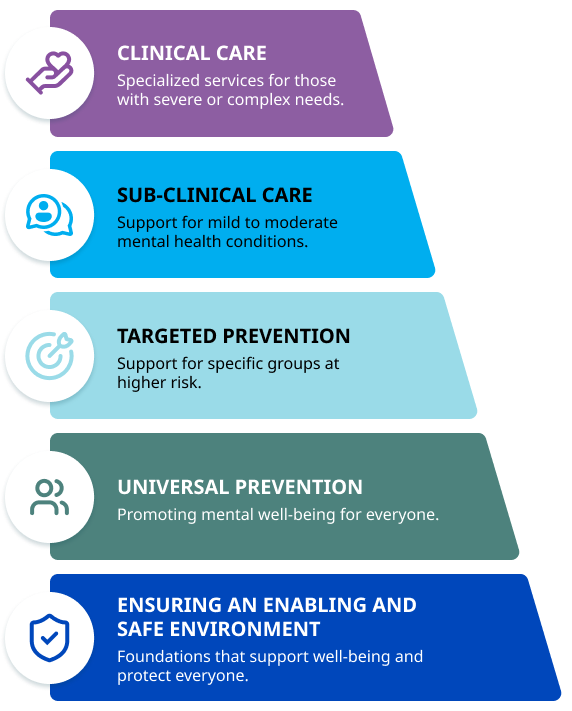
- Level 5
- Level 4
- Level 3
- Layer 2
- Layer 1

For the system to function as intended, young people, families, caregivers and communities must be active partners throughout, defining priorities, shaping and implementing responses and supporting monitoring and evaluation. Progress should be systematica
Phase 1
Identifying the Problem
Effective policy starts with a clear, evidence-based understanding of the challenges and the factors driving them. This phase helps you build a comprehensive picture of the mental health challenges facing young people face in your context, identify the factors that shape them, and and establish a strong foundation for informed policy action.
Step 1.1
Define the problem and build your evidence base
Why it matters
How a problem is framed shapes that the response that follows: from the interventions selected and the sectors involved, to the way success is defined and measured. For child and adolescent mental health and wellbeing, adopting a systemic perspective, that considers social, structural and environmental determinants, can reveal a broadrange of entry points for effective policy action.
What to do
- Gather data on the prevalence and distribution of mental health conditions among children and adolescents.
- Identify which groups are disproportionaly affected by mental health challenges, paying attention to gender, age, socioeconomic status, disability, migration status, and exposure to abuse, discrimination, harmful online experiences, violence, or other adverse social, digital, and environmental conditions.
- Look at trends over time: is the situation improving or deteriorating, and for whom?
Key resources
- Map the key determinants shaping mental health outcomes including family and peer relationships, school environments, socioeconomic conditions, digital environments and access to services and support.
- Identify both protective factors that strengthen young people's mental health and well-being and risk factors that may undermine it.
- Use a multisectoral situation analysis to capture the range of determinants influencing young people’s mental health and well-being.
Key resources
- Examine governance structures, workforce capacity, financing, and the availability, accessibility and coverage of services across health, education, social and other relevant sectors.
- Identify gaps and barriers that prevent systems and services from reaching and adequately supporting those who need them most.
- Compare system's capacity and performance against relevant regional and international standards, benchmarks and good practices, taking the national and local context into account.
Key resources
- Systematically identify how different groups of children and adolescents are affected by current policies and gaps in provision.
- Use a child rights impact assessment to ensure your analysis captures children in the most vulnerable and marginalised situations.
Key resources
Questions to guide your work
- Which children and adolescents in our country are experiencing the worst mental health outcomes, and what is driving this?
- What data do we have on trends over time and where are the gaps?
- How well are our current systems equipped to prevent and respond to mental health problems?
- Who is not being reached by existing services, and why?
Step 1.2
Review European and international frameworks
Why it matters
National policies do not exist in isolation. In the EU, a coherent set of strategic and policy frameworks support action on child and adolescent mental health and wellbeing, underpinned by a rights-based approach and the recognition of every child’s right to the highest attainable standard of health and well-being t. The right is enshrined in the UN Convention on the Rights of the Child and the EU Charter of Fundamental Rights. Understanding these frameworks helps you align your national action with broader regional commitments, access shared evidence and tools, and make the case for investment and reform at national and regional level.
What to do
- Review the key frameworks and identify how they apply to your national context.
- Use them to strengthen the evidence base and legitimacy of your objectives.
- Identify obligations and commitments your country has already made.
- Look for alignment between proposed actions and regional priorities, as this can support advocacy for resources.
Step 1.3
Define your policy objectives
Why it matters
Clear objectives give direction to everything that follows: they guide the design of interventions, support coordination across sectors, and provide the basis for monitoring progress. Vague objectives or objectives focused only on treatment tend to produce fragmented, reactive responses. Prevention-oriented, cross-sectoral objectives are more likely to drive lasting change.
What to do
- For each objective, make the link explicit: what evidence or identified need does it respond to?
- Frame objectives to enable coordination across health, education, social services and other relevant sectors.
- Ensure objectives are measurable: identify what change would look like and how you would know if it has happened.
- Balance short-term, deliverable actions with longer-term structural goals.
- Orient objectives towards promotion and prevention, not just treatment.
A useful way to organise objectives:
Phase 2
Identifying Solutions and Entry Points
Once you have a clear picture of the problem, this phase helps you assess what is already in place, identify evidence-based solutions, and plan how to address gaps. The goal is a coherent, set of actions, not a collection of disconnected programmes.
Step 2.1
Review existing national policies and frameworks
Why it matters
Before developing new policies, it is essential to understand what is already in place and if this is working or not. A structured review helps identify gaps in coverage, coordination challenges, underserved populations, and lessons from previous implementation. It also avoids duplicating effort or undermining existing effective programmes.
What to do
Conduct a structured review across five domains:
- Examine what parenting support and early development policies exist.
- Assess whether they include a mental health component.
- Identify gaps in reach, particularly for families in vulnerable and marginalised situations.
Key resources
- Assess whether wellbeing approaches are embedded in schools.
- Map what support services are available in educational settings, and who can access them.
- Identify gaps in provision, coordination or staff capacity.
Key resources
- Assess whether children have access to safe spaces, community support and opportunities for participation.
- Identify gaps in community-based services, particularly for children facing disadvantage.
Key resources
- Examine what protections exist online for children and young people.
- Assess whether children and families are supported to tackle digital risks.
- Identify gaps in regulation, digital literacy provision and targeted support.
Key resources
- Examine how poverty, housing, migration status and other structural factors shape mental health outcomes.
- Identify which population groups are most affected by structural disadvantage.
- Assess whether current policies actively address inequalities in access and outcomes.
Key resources
For each domain, assess:
- Whether existing policies actively support promotion and prevention (not just treatment).
- Gaps in coverage, coordination or implementation.
- Which population groups are not being adequately reached.
- What barriers have affected implementation in the past and what has enabled success.
- How current policies align (or don't) with European and international frameworks.
Questions to guide your review
- What do we already have that is working well and should be protected or scaled?
- Where are the biggest gaps in provision, coordination or population reach?
- What can we realistically build on within existing systems, rather than creating from scratch?
Step 2.2
Identify good practice solutions
Why it matters
A strong, evidence-based mental health response requires the full continuum of interventions working across sectors, from system-wide structural conditions that shape population-level wellbeing to targeted support for those at highest risk. The Pyramid shown above organizes this continuum into five layers: enabling environments (promotion), universal prevention, targeted prevention, subclinical care and clinical care. Because this toolkit focuses specifically on promotion and prevention, building protective conditions and reducing risk before problems escalate, it draws on the first three layers. The fourth and fifth layers, which address treatment and clinical response, fall outside its scope. Across the three layers covered, the evidence points to a set of common principles: practices are most effective when they are intersectoral, involve trained workforces across sectors, and are embedded in supportive policy frameworks.
What to do: work across three layers
Layer 1 — Enabling and safe environments (promotion)
This layer focuses on the structural conditions, policies and governance arrangements that shape mental health outcomes at system level, creating the environments in which all children can thrive.
- Invest in parenting support programmes delivered through health, social care and community services, particularly for families facing socioeconomic disadvantage.
- Consider nationally coordinated approaches such as community-based integrated family centres (bringing together health, social care and education in a single service point) or structured home-visiting services for vulnerable families.
- Implement structured, evidence-based parenting programmes (e.g. Incredible Years, Strengthening Families) through local schools, health centres and community organisations.
Key resources
- Develop and implement whole-school approaches to wellbeing that go beyond individual programmes, establishing a shared school culture, engaging leadership, families and staff, and sustaining commitment over time.
- Invest in staff mental health training and literacy programmes to equip teachers and school professionals to recognise and respond to mental health needs.
- Create safe, inclusive school climates by addressing bullying systematically and building social connectedness.
Key resources
- Embed mental health promotion across relevant policy domains — education, housing, social protection, and digital environments.
- Address digital determinants of mental health: regulate harmful online content, promote digital literacy, and mitigate risks associated with social media and AI.
- Invest in stigma reduction through public awareness campaigns and workforce training across all sectors.
Key resources
Layer 2 — Universal prevention
Universal prevention targets all children and adolescents, regardless of risk level, with the aim of building resilience, promoting wellbeing and preventing the onset of mental health difficulties. Schools and community-based services are the primary settings.
- Integrate social and emotional learning (SEL) into the curriculum, building children's capacity to recognise and manage emotions, develop positive relationships and make responsible decisions.
- Implement mental health literacy programmes for students to understand mental health, reduce stigma and seek help.
- Address emerging prevention needs, including those related to digital media use, substance use and behavioural risk.
- Consider life skills curricula that can be tailored to specific prevention goals across different age groups.
Key resources
- Invest in low-threshold community services that offer timely, non-stigmatising support with minimal barriers — no referral required, free or low-cost, with online or hybrid options.
- Consider peer-based models that involve trained young volunteers alongside professionals, extending reach into social environments where young people feel comfortable.
- Ensure these services function as entry points connected to more specialised support where needed.
Key resources
- Strengthen primary care and child health services as universal platforms for early identification and prevention.
- Embed mental health within routine child health contacts and well-care visits.
Key resources
Layer 3 — Targeted prevention
Targeted prevention focuses on children and adolescents at higher risk, providing early, coordinated and proportionate support before difficulties escalate. Key risk factors include family adversity, socioeconomic disadvantage, parental mental health difficulties, exposure to trauma, problematic digital media use, and belonging to marginalised groups.
- Set up clear systems for early identification of need and referral pathways across health, education and social services.
- Embed screening and clinical coordination within schools. For many children, school is the only institutional setting where emerging needs can be identified.
- Develop coordinated, multi-agency service responses that avoid fragmentation and ensure continuity of care.
Key resources
- Support parental mental health as an entry point for intervention, and invest in postpartum depression screening and support.
- Target socioeconomically disadvantaged families with intensified support delivered through health, social care and community services.
- Address problematic digital media use through targeted school-based prevention programmes for students already showing signs of difficulty.
- Ensure accessible, culturally sensitive support for marginalised groups, including children with migration or refugee backgrounds, LGBTQIA+ adolescents, and those involved in justice or welfare systems.
Key resources
- Implement suicide prevention programmes that combine frontline professional training, public awareness and low-barrier access to early support.
- Invest in digital and community-based tools that can reach young people who face barriers to conventional services.
Key resources
* Innovative practices: included for the emerging needs they address, though not yet meeting all core assessment criteria (effectiveness, evidence base, transferability and scalability).
Step 2.3
Identify stakeholders, tools and coordination structures
Why it matters
Even well-designed policies fail if the right people are not involved, responsibilities are unclear, or coordination breaks down. This step ensures your policy has the governance, partnerships and participation structures it needs to be implemented effectively.
What to do
- Identify who needs to be involved, and in what role.
- Think beyond the health sector: education authorities, social services, local government, civil society, children and families all have a role to play.
- Determine what structures will enable sustained cross-sector working.
- These might include joint planning groups, shared data platforms, or co-located services.
- Determine what combination of legislation, strategies, programmes and guidance is right for your context and level of governance.
- Ensure children, adolescents and caregivers have a genuine voice — not just in consultation events, but embedded in governance, co-design and review processes.
Questions to guide your work
- Who needs to be at the table for this policy to succeed and who is currently missing?
- How will we ensure that children and young people have a real voice, rather than being consulted only formally?
- What coordination structures already exist that we could use or strengthen?
Phase 3
Implementation and Monitoring
Having a good policy on paper is not enough. This phase focuses on how to make it work in practice, through existing systems, with clear accountability, and with monitoring built in from the start.
Step 3.1
Implement through existing systems
Why it matters
Sustainable implementation means embedding policy actions within health, education and social service systems, not running them as separate projects. When mental health actions are integrated into routine practice, they are more likely to reach those who need them, be adequately resourced, and survive changes in political leadership or funding.
What to do
- Define who is responsible for what across national, regional and local levels.
- Establish clear lines of accountability within each sector and across sectors.
- Agree on how decisions will be made and how disputes will be resolved.
- Set up regular coordination between health, education and social services, including shared referral pathways and data-sharing agreements.
- Identify a lead coordinating body with the mandate and capacity to drive implementation.
- Build in mechanisms for joint problem-solving when things go wrong.
Key resources
- Workforce: ensure frontline staff in health, education and social services have the training, tools and time to address mental health.
- Financing: map current spending, identify gaps, and advocate for sustained investment, including for prevention, not just treatment.
- Guidance: provide practical implementation support and technical guidance at every level of the system.
Key resources
Questions to guide your work
- How will this policy be funded and is that funding sustainable?
- What workforce capacity is needed and what gaps exist?
- How will we maintain cross-sector coordination when there is pressure to work in silos?
Step 3.2
Monitor performance, equity and system functioning
Why it matters
Monitoring is how you learn whether your policy is working, and for whom. Without it, you cannot identify what needs to change, demonstrate impact, or hold systems accountable. Monitoring should be built into policy design from the beginning, not added on at the end.
What to do
- Set up monitoring across four dimensions: (1) who is being reached by services and where gaps persist; (2) whether mental health outcomes are improving at population level; (3) whether inequalities in outcomes and access are narrowing; and (4) whether the system itself - workforce, financing, services - is strengthening over time.
Key resources
- Draw on established indicators and measurement tools to enable comparison over time and across countries.
Key resources
- Build in regular review cycles where monitoring evidence can trigger adjustments to policy and implementation.
- Monitoring is only useful if it feeds into real policy processes.
- Track outcomes disaggregated by gender, age, socioeconomic status, migration status and other relevant factors.
- Average improvements can mask growing inequalities.
Key resources
Questions to guide your monitoring
- Are the children who need support most actually being reached?
- Are inequalities in mental health outcomes narrowing or widening?
- Is our monitoring data feeding into real decisions, or just being collected?
- Are we tracking the inputs (services, workforce) as well as the outcomes?