Toolkit guide
Source
European Commission
Topic
Digital determinants
Tools & Frameworks
EU policy framework
Language
EN
Use it to…
align national action on children's digital wellbeing with the emerging EU regulatory framework for online safety.
Where to look in this resource
The accompanying Communication ('An EU approach to online child safety') giveS the most accessible overview; the proposal itself sets out the age rules and safety-by-design obligations, and the Staff Working Document analyses expected impacts.
Area
1.2
Description

Adopted by the European Commission on 17 September 2026, the proposal sets a harmonised EU framework for children's online safety built on four pillars: delayed access to social media, safety by design, age assurance and parental responsibility, and strong enforcement. It would prohibit social media accounts under 13, allow parent-supervised accounts at 13–14 and independent accounts from 15, and require services such as social media, video platforms, online games, AI chatbots and app stores to avoid design features that drive excessive use. It is still a proposal and must be negotiated by the European Parliament and the Council.

Brief description
Proposed EU regulation setting common age rules and safety-by-design obligations for digital services used by children.
Country
EUROPE
Keywords
online safety, social media age limits, safety by design, age verification, parental tools, EU regulation, digital determinants
Resource Title
Proposal for EU KIDS Act - 'EU Keeping Internet Digital Spaces Accountable and Trustworthy' - Shaping Europe’s digital future (European Commission, 2026)
Source
European Commission
Topic
Digital determinants
Tools & Frameworks
Report
Language
EN
Use it to…
benchmark national data on adolescents' screen and social media use and build the evidence case for action on the digital determinants of mental health.
Where to look in this resource
Read the report as a whole — it covers screen time, social media use and self-reported mental and physical health symptoms (Action 1), and the role of age of first social media use, online content and parents (Action 2). Country-level results allow national benchmarking.
Area
1.1
Description

Conducted for the European Commission (DG SANTE) in spring 2026, the survey gathered responses from over 26,000 adolescents aged 13–18 and more than 12,700 parents across all 27 Member States. It provides comparable data on the prevalence, intensity and contexts of screen and social media use, and shows a consistent association between screen time and reported symptoms such as sleep problems, fatigue, concentration difficulties, stress and anxiety, with earlier social media use linked to heavier screen time. The findings describe statistical associations based on self-reported data rather than causal effects.

Brief description
EU-wide survey of adolescents and parents on screen and social media use and its links with mental and physical health.
Country
EUROPE
Keywords
screen time, social media, adolescents, parents, sleep, anxiety, Eurobarometer, EU27
Resource Title
European Commission. Impact of excessive screen time and social media on young people's mental health. Flash Eurobarometer 579
Topic
Promising practice — long-term (12-year) relational mentoring, sport-based engagement, equity focus on children at risk of social exclusion, cross-sectoral, cost-effective.
Tools & Frameworks
Good practice
Language
EN
Use it to…
Use it to help identify, adapt, and apply effective solutions for long-term, relationship-based support that reaches children at risk of social exclusion.
Where to look in this resource
The whole page is relevant - it summarises the main characteristics of the practice.
Setting
Area
2.2
Description

Founded in Finland in 1996, Icehearts forms teams of around 20 children identified early (around age 6) by pre-school, school and social services as needing special support. A full-time mentor stays with the same team for 12 years, until around age 18, using team sport as the entry point while supporting children at school, during leisure time, individually and through their families, in collaboration with other services. It is rooted in a salutogenic, rights-based approach, and is being piloted in other European countries through the Icehearts Europe project.

Brief description
12-year, sport-based mentoring programme for children at risk of social exclusion (Finland).
Country
Finland (origin); pilots in Denmark, Estonia, Italy, Slovenia, Spain
Keywords
mentoring, team sport, long-term support, social exclusion, family support, Targeted prevention, Promotion, cost-effectiveness

Resource Title
Icehearts
Source
JA ImplemMENTAL
Topic
Targeted mental health prevention
Tools & Frameworks
Handbook
Language
EN
Relevant actions
Action 3
Use it to…
draw on practical lessons from a European national programme that can be adapted in other contexts.
Where to look in this resource
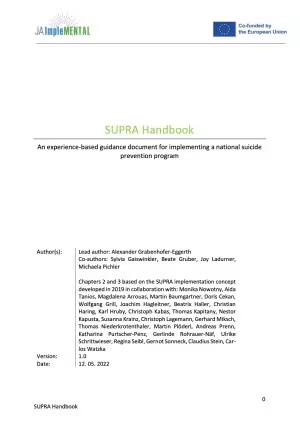
The SUPRA concept of implementation is structured around six “Columns” — Coordination and organisation; Support and treatment; Restriction of access to means; Awareness and knowledge; Embedment in prevention and health promotion; and Quality assurance and expertise — set out with a stepwise implementation approach and monitoring and evaluation guidance.
Image
SUPRA Handbook: An experience-based guidance document for implementing a national suicide prevention program (JA ImpleMENTAL 2022)
Age group
Setting
Area
3.1
Description

A practical guide based on Austria’s experience implementing its national suicide prevention programme, designed to help other countries develop similar strategies. It outlines a structured approach aligned with WHO guidance, covering how to set priorities, coordinate stakeholders, and translate strategy into actionable steps. The handbook also highlights key lessons on governance, implementation, and evaluation, providing adaptable tools and examples to support effective, evidence-based suicide prevention efforts

Brief description
Handbook to guide other countries in developing or scaling up their own national or regional suicide prevention strategies.
Country
EUROPE
Keywords
national suicide prevention programme, stakeholder coordination, governance, adaptable lessons
Resource Title
SUPRA Handbook: An experience-based guidance document for implementing a national suicide prevention program (JA ImpleMENTAL 2022)
Source
WHO
Topic
Targeted mental health prevention
Tools & Frameworks
Implementation Guide
Language
EN
Relevant actions
Action 3
Use it to…
structure national suicide-prevention planning, coordination and implementation.
Where to look in this resource
Part A sets out the LIVE LIFE core pillars (multisectoral collaboration; awareness-raising and advocacy; financing; surveillance; and monitoring and evaluation) — the foundations for coordinated implementation; Part B sets out the four key interventions (limit access to means; responsible media reporting; foster socio-emotional life skills in adolescents; and early identification, assessment, management and follow-up).
Image
LIVE LIFE: An implementation guide for suicide prevention in countries (WHO 2021)
Age group
Setting
Year
2021
Area
3.1
Description

 A practical implementation guide that sets out a simple, evidence-based framework to help countries initiate or strengthen suicide prevention efforts. It focuses on four key interventions—such as limiting access to means, promoting responsible media reporting, building life skills in young people, and improving early identification and care—supported by cross-cutting pillars like governance, collaboration, and monitoring. Designed for both national and local stakeholders, the guide provides a structured starting point for developing coordinated, multi-sector suicide prevention strategies that can be adapted to different contexts.

Brief description
WHO implementation guide for developing or strengthening national suicide prevention strategies.
Country
INTERNATIONAL
Keywords
life skills, early identification, governance, suicide
Resource Title
LIVE LIFE: An implementation guide for suicide prevention in countries (WHO 2021)
Source
UNICEF
Topic
PHC system strengtening
Tools & Frameworks
Framework
Language
EN
Relevant actions
Actions 2 & 3
Use it to…
Support integration of mental health promotion and early support into primary health care and routine child services.
Where to look in this resource
The framework is organised around 14 “levers” in two groups — Core strategic levers (political commitment and leadership; governance and policy frameworks; funding and allocation of resources; engagement of communities and stakeholders) and Operational levers (models of care; workforce; physical infrastructure; quality; monitoring and evaluation; and others). The governance and stakeholder-engagement levers speak to cross-sector coordination (Action 2); the funding, models-of-care, workforce and infrastructure levers to the enabling conditions (Action 3).
Image
Operational Framework for Primary Health Care (UNICEF 2020)
Age group
Setting
Year
2020
Area
3.1
Description

Outlines strategic and operational levers that countries can use to implement PHC effectively. The framework includes a measurement system to track progress and performance in PHC, ensuring that health systems can adapt and respond to changing needs and challenges.

Brief description
Framework outlining how countries can strengthen primary health care systems and track their performance.
Country
INTERNATIONAL
Keywords
Primary Healthcare, measurement system, integration, performance tracking, routine child services
Resource Title
Operational Framework for Primary Health Care (UNICEF 2020)
Source
WHO
Topic
Guaranteeing access to early intervention and mental health services and support
Tools & Frameworks
Guidelines
Language
EN
Relevant actions
Actions 2 & 3
Use it to…
organise coordinated, multi-level service delivery across sectors
Where to look in this resource
The “Strengthening systems” chapter (standards, governance, family and youth participation, financing, workforce and information systems) is the most relevant for cross-sector coordination and the enabling conditions; the “Designing and delivering services” chapter covers how services are organised and integrated across the health and non-health sectors.
Image
Mental health of children and young people: service guidance (WHO 2025)
Setting
Year
2025
Area
3.1
Description

Outlines key principles and standards for designing and delivering effective mental health services for children and young people. It focuses on service organisation, accessibility, quality of care, and integration across sectors, helping countries strengthen systems to better meet the needs of young populations.

Brief description
Guidance on organising accessible, high-quality mental health services for children and young people.
Country
INTERNATIONAL
Keywords
service organisation, accessibility, quality of care, integration, standards
Resource Title
Mental health of children and young people: service guidance (WHO 2025)
Source
WHO
Topic
Guaranteeing access to early intervention and mental health services and support
Tools & Frameworks
Guidelines
Language
EN
Relevant actions
Layers 1, 2 & 3
Use it to…
Identify interventions with a strong evidence base to prioritise for policy adoption and scale-up.
Where to look in this resource
The “Summary of recommendations” sets out the headline interventions to prioritise across the layers, and the “Evidence and recommendations” section gives the evidence behind each; the detailed evidence summaries are in the annexes.
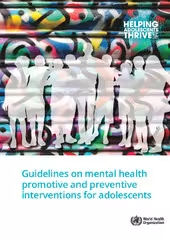
Image
Guidelines on promotive and preventive mental health interventions for adolescents (WHO 2021)
Setting
Year
2021
Area
2.2
Description

Evidence-based recommendations on interventions that promote mental well-being and prevent mental health conditions among adolescents. Drawing on systematic reviews, the resource outlines effective approaches across settings—such as schools, families, and communities—supporting countries in implementing interventions that are both impactful and appropriate to adolescents’ developmental needs.

Brief description
WHO recommendations on evidence-based interventions to promote adolescent mental wellbeing and prevent mental health conditions.
Country
INTERNATIONAL
Keywords
promotion, prevention, systematic review, scale-up, evidence-based interventions
Resource Title
Guidelines on promotive and preventive mental health interventions for adolescents (WHO 2021)
Source
WHO
Topic
monitoring adolescent health
Tools & Frameworks
Guidelines
Language
EN
Relevant actions
Actions 1 & 2
Use it to…
track mental health and wellbeing outcomes using a standardised, comparable framework.
Where to look in this resource
The “Subjective well-being” and “Health outcomes and conditions” indicators provide the standardised, comparable measures to track; the measurement principles set out how to collect and use them consistently over time.
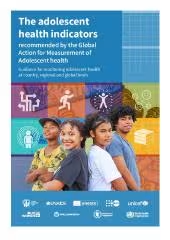
Image
The adolescent health indicators recommended by the Global Action for Measurement of Adolescent health (WHO) -GAMA
Setting
Area
3.2
Description

An international initiative launched in 2018 to improve the consistency and quality of data on adolescent health and well-being worldwide, addressing longstanding gaps in how the needs of young people aged 10–19 are understood and monitored. Developed in collaboration with key UN partners, it establishes a standardized framework of indicators across multiple domains, including health outcomes, behaviours, and social determinants. Its relevance to child and adolescent mental health lies in its holistic approach, which embeds mental health within broader measures of well-being rather than treating it in isolation. By incorporating indicators related to emotional well-being, risk exposure, and environmental influences, GAMA enables more reliable tracking of mental health needs and highlights the complex factors shaping outcomes during adolescence—a critical developmental period when many mental health conditions first emerge. This integrated, data-driven approach supports more effective policy, prevention, and service planning, ultimately strengthening global efforts to promote mental health and well-being among children and adolescents

Brief description
WHO guidance presenting a recommended set of indicators for monitoring adolescent health.
Country
INTERNATIONAL
Keywords
AMA, indicator framework, UN collaboration, well-being determinants, data standardisation
Resource Title
The adolescent health indicators recommended by the Global Action for Measurement of Adolescent health (WHO) -GAMA
Source
WHO
Topic
Mental healh
Tools & Frameworks
Database
Language
EN
Relevant actions
Actions 1 & 2
Use it to…
benchmark system-level indicators on governance, workforce, financing and service availability.
Where to look in this resource
The data on governance, financing, workforce and service availability and coverage provide the standardised system-level indicators to benchmark and track over time - alongside your country profile.
Image
Mental Health Atlas 2024 (WHO 2025)
Age group
Setting
Year
2013
Area
3.2
Description

Compiles global data on mental health systems, including policies, services, workforce, and financing. It enables countries to track progress, identify gaps in care, and benchmark against international targets, supporting efforts to strengthen mental health systems and improve access to services. Country level data is presented in the country profiles available on the website.

Brief description
Global WHO database tracking countries’ mental health policies, services, workforce and financing.
Country
INTERNATIONAL
Keywords
Mental Health Atlas, country profiles, workforce, financing, benchmarking
Resource Title
Mental Health Atlas 2024 (WHO 2025)