Toolkit guide
Topic
ECD
Tools & Frameworks
Tools & Frameworks
Language
EN
Use it to…
Offers evidence-based guidance on preventing, identifying and addressing developmental difficulties in young children. It highlights effective strategies for early detection and intervention, helps inform the design of integrated early childhood development services, and offers practical recommendations for strengthening health and support systems in resource-constrained settings
Where to look in this resource
Understand available evidence regarding prevention, identification and intervention for developmental difficulties
Image
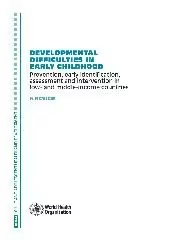
Developmental difficulties in early childhood: prevention, early identification, assessment and intervention in low- and middle-income countries: a review

Area
2.1
Description

The review examines risk factors, prevention strategies, approaches to early identification and assessment, and evidence-based interventions, with a particular focus on strengthening the capacity of health systems and frontline providers to support children and families in low- and middle-income settings.

Brief description
A comprehensive overview of the evidence on developmental difficulties in children aged 0-3 years, including cognitive, language, social-emotional, behavioural and neuromotor development.
Keywords
developmental disabilities; early identification; intervention; prevention; health systems
Resource Title
Developmental difficulties in early childhood: prevention, early identification, assessment and intervention in low- and middle-income countries: a review
Topic
Parenting support, ECD
Tools & Frameworks
Tools & Frameworks
Language
EN
Use it to…
Provides important guidance for advocacy and policy design for advancing universal-progressive home visiting model for young children and families.
Where to look in this resource
Informs policy design for a UPHV model
Area
2.1
Description

Describes the key features of the Universal Progressive Home Visiting (UPHV) model, a health systems approach that provides structured support to all families with young children while offering additional, targeted support to those with greater needs. The resource outlines the principles, service components and delivery mechanisms of effective home visiting programmes, highlighting their role in promoting child health, development, responsive caregiving and family well-being during the early years

Brief description
Describes the key features of the Universal progressive model of home visiting for young children and their families,
Keywords
universal progressive model; home visiting; parenting support; policy; health systems
Resource Title
Universal Progressive Home Visiting: A health systems strategy for early childhood
Topic
Parenting support, ECD
Tools & Frameworks
Studies
Language
EN
Relevant actions
Action 10
Use it to…
The Policy Brief offers useful advocacy and policy guidance for promoting home visiting for young children and families as a key strategy to improve health and development in early chidhood.
Where to look in this resource
Advocacy and policy guidance for promoting home visiting for young children and families as a key strategy to improve health and development in early childhood.
Area
2.2
Description

Summarises findings from a series of systematic literature reviews on the effectiveness of HV programmes in middle- and high-income countries, highlighting benefits for young child health and development, as well as maternal wellbeing nd parenting. Identifies the main implications of the findings for policy and practice and outlines key considerations for implementation.

Brief description
A Policy brief providing an overview of the key effects of home visiting services on child health and wellbeing in high- and middle-income countries.
Keywords
policy; home visiting; evidence-based; programme design; child development
Resource Title
Policy brief: The effects of home visiting programmes on key dimensions of the well-being of children and families in high and middle-income countries. Evidence for policy and program design
Topic
Parenting support, ECD
Tools & Frameworks
Studies
Language
EN
Relevant actions
Action 10
Use it to…
Can inform advocacy and policy design to enhance the health and development of young children, with a specific focus on home visiting services.
Where to look in this resource
Inform advocacy and policy design to enhance the health and development of young children, with a specific focus on home visiting services
Area
2.2
Description

The report synthesises evidence from a literature review of studies in high- and middle-income countries to assess the effectiveness of two types of home visiting (HV) programmes – universal and targeted – and identify their key programme components. It describes the study methods and analysis, main findings, and their interpretations. The report positions HV as an important component of care for young children's health and development, and highlights the poential of uniersal-progressive model of HV to maximise impact and equity.

Brief description
A synthesis of evidence from a literature review of studies in high- and middle-income countries to assess the effectiveness of two types of home visiting programmes – universal and targeted
Keywords
home visiting; evidence; child development outcomes; parenting; family well-being
Resource Title
The effects of home visiting programmes on key dimensions of the well-being of children and families in high- and middle-income countries. A synthesis of evidence. Report
Topic
Developmental monitoring and early detection
Tools & Frameworks
Tools & Frameworks
Language
EN
Relevant actions
Action 3
Use it to…
It can be integrated into primary health care as a tool to support professionals in ongoing developmental monitoring and in supporting families in promoting early child development.
Where to look in this resource
A unique package for monitoring and supporting early childhood development that can be used by trained providers to assess the development of children from birth to 3.5 years of age and deliver individualised support
Image
Guide for Monitoring Child Development (GMCD)
Area
2.2
Description

The international Guide for Monitoring Child Development (GMCD) is a unique package for monitoring and supporting early childhood development that can be used by trained providers to assess the development of children from birth to 3.5 years of age and to deliver developmental support individualized for each child, family, and community. Open surce tool.

Brief description
Validated, open-source tool for developmental monitoring.
Keywords
developmental monitoring; primary care; early identification; child development; surveillance
Resource Title
Guide for Monitoring Child Development (GMCD)
Topic
Developmental monitoring and early detection
Tools & Frameworks
Tools & Frameworks
Language
EN
Relevant actions
Action 3
Use it to…
Can be integrated in primary health care as a tool supporting professionals in their ongoing developmental monitoring efforts and early detection of developmental difficulties.
Where to look in this resource
A validated, parent‑centred method for early identification of developmental and behavioural concerns in children from birth to age 8, supporting timely referral and intervention.
Image
PEDS (Parent Evaluation of Developmental Status)
Area
2.2
Description

PEDS developmental screening is a validated, parent‑centered method for early identification of developmental and behavioral concerns in children from birth to age 8, supporting timely referral and intervention.

Brief description
PEDS developmental screening refers to the Parents’ Evaluation of Developmental Status (PEDS) and PEDS‑R®, evidence‑based tools used to identify developmental, behavioral, and social‑emotional concerns in children from birth to age 8.
Keywords
developmental surveillance; parent centred; screening; early identification; referral
Resource Title
PEDS (Parent Evaluation of Developmental Status)
Topic
Developmental monitoring and early detection
Tools & Frameworks
Tools & Frameworks
Language
EN
Relevant actions
Action 3
Use it to…
Can be integrated in primary health care as a tool supporting professionals in their ongoing developmental monitoring efforts and early detection of developmental difficulties.
Where to look in this resource
An example of a widely used developmental screening tool for children aged 1 month to 5½ years
Image
Ages and Stages Questionnaire (ASQ-3)
Area
2.2
Description

The Ages & Stages Questionnaires® (ASQ-3) is a widely used developmental screening tool for children aged 1 month to 5½ years. It is parent-centric, easy to use, and helps identify developmental progress or potential delays. It is designed for use by early educators and health care professionals. It relies on parents as experts, is easy-to-use, family-friendly and creates the snapshot needed to catch delays and celebrate milestones in communication, gross motor, fine motor, problem solving, and personal-social skills.

Brief description
The Ages & Stages Questionnaires® (ASQ-3) is a widely used developmental screening tool for children aged 1 month to 5½ years
Keywords
developmental screening; assessment; milestones; early detection; monitoring
Resource Title
Ages and Stages Questionnaire (ASQ-3)
Topic
ECI
Tools & Frameworks
Tools & Frameworks
Language
EN
Relevant actions
Action 6
Use it to…
It offers key considerations for the design of early childhood intervention policies and services. It is also a valuable resource for professionals working to support young children with developmental concerns, delays or disabilites and their families.
Where to look in this resource
Highlights key considerations for the design of early childhood intervention policies and services
Area
2.2
Description

The National Best Practice Framework for Early Childhood Intervention (ECI) gives clear advice on how to support children under 9 years of age who have developmental concerns, delays, or disabilities. It helps families and professionals understand what good support looks like and how to provide it. It highlights evidence-based practice, underlying principles and offers practical tools and resources for implementation.

Brief description
The National Best Practice Framework for Early Childhood Intervention describes what high-quality evidence-informed support for young children with developmental difficulties looks like
Keywords
early intervention; disability; family-centred care; best practice; inclusion
Resource Title
Australia's National Best Practice Framework for Early Childhood Intervention
Topic
ECI
Tools & Frameworks
Best practices
Language
EN
Relevant actions
Action 5
Use it to…
Help understand how national early childhood intervention systems in selected countries are organised to deliver evidence-based, family-centred services to children with developmental difficulties and their families.
Where to look in this resource
Understand how national early childhood intervention systems in selected countries are organised to deliver evidence-based, family-centred services to children with developmental difficulties and their families
Image
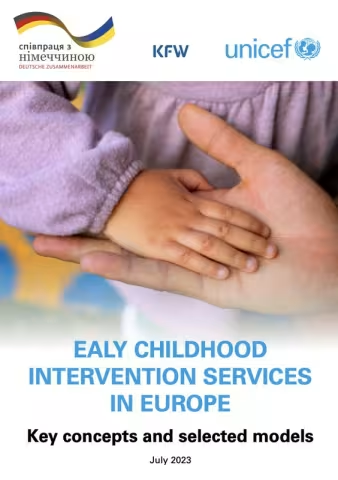
Selected ECI Models
Area
2.2
Description

Describes the key features of evidence-based, family-centred early childhood intervention services and how they are organised in Portugal, Serbia, Georgia and the Czech Republic.

Brief description
Provides an overview of selected national systems for early childhood intervention for children with developmental difficulties and their families in Europe and Central Asia.
Keywords
early childhood development; equity; well-being; child rights; policy
Resource Title
Selected ECI Models
Topic
Parenting support
Tools & Frameworks
Tools & Frameworks
Language
EN
Use it to…
Can inform innovative, digital solutions to provide parenting support to families with young children.
Where to look in this resource
Informs innovative, digital solutions to provide parenting support to families with young children.
Image
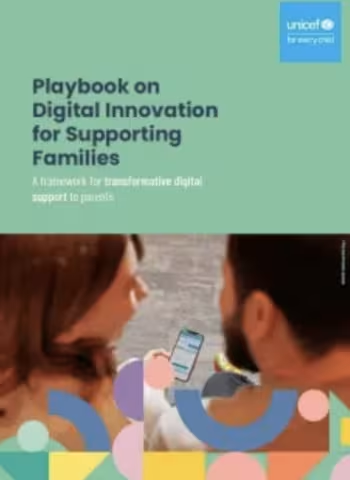
Playbook on Digital Innovation for Supporting Families:. A framework for transformative digital support to parents
Area
2.1
Description

The Playbook presents a clear roadmap for leveraging digital innovation across four priority action areas, including i) providing trusted information and guidance, ii) strengthening family empowerment and skill-building, iii) fostering connection and community, and iv) enabling access to quality services. Digital innovations, when designed well, can fundamentally reshape support available to families - making it more timely, more relevant and more accessible.

Brief description
The Playbook on Digital Innovation for Supporting Families is a practical framework developed to help governments, practitioners, innovators, and partners design more human-centered, equitable, and scalable digital support ecosystems for families.
Keywords
digital innovation; parenting support; technology; service delivery; family engagement
Resource Title
Playbook on Digital Innovation for Supporting Families:. A framework for transformative digital support to parents