Toolkit guide
Source
WHO
Topic
child and youth mental health
Tools & Frameworks
Report
Language
EN
Relevant actions
Actions 1 & 3
Use it to…
situate national data in a regional context and identify gaps in governance, workforce, services and quality of care.
Where to look in this resource
RELEVANT FOR ACTION 1
The “Results” (population needs and trends — burden and status) and the “Summary”
RELEVANT FOR ACTION 3
The “Results” (workforce, services, governance and the treatment gap) and the “Proposed actions to improve the quality of CAYMH care”
Image
Child and youth mental health in the EURO region (WHO EURO 2025)
Setting
Year
2025
Area
1.1
Description

A comprehensive regional data synthesis, bringing together the latest available evidence on child and youth mental health (CAYMH) across the WHO European Region. It compiles and analyses data on population needs, emerging trends, and the current state of support systems, including governance, workforce capacity, service provision, and quality of care (QoC). By consolidating this information, the report both reinforces existing recommendations and identifies key gaps, proposing nine additional actions to strengthen the quality and effectiveness of care.

Brief description
Regional evidence review on child and youth mental health needs, systems, services and quality of care in Europe.
Country
EUROPE
Keywords
CAYMH, governance, workforce, quality of care, regional synthesis
Resource Title
Child and youth mental health in the EURO region (WHO EURO 2025)
Source
UNICEF
Topic
needs assessment
Tools & Frameworks
Guidelines
Language
EN
Relevant actions
Actions 2 & 3
Use it to…
Conduct a structured cross-sector mapping of needs, gaps and implementation barriers.
Where to look in this resource
A short, practical guide — it takes you through a structured situational analysis via four sets of “Key questions” (programme implementation and service delivery; multisectoral collaboration; financing, policy and legislation; and stigma, social norms and attitudes) and a “Methodologies” section. Most of it speaks to Action 3 (services and systems), with the stigma and norms questions also informing Action 2.
Setting
Area
1.1
Description

A structured approach to assessing needs, services, and system capacity across sectors. It supports a comprehensive understanding of how determinants, service provision, and coordination mechanisms interact, enabling the identification of gaps and priority areas for action. While originally developed for diverse country contexts, the approach is adaptable to European settings and can strengthen evidence-informed policy development by supporting systematic analysis of child and adolescent mental health systems and their underlying drivers.

Brief description
Practical guidance for conducting a multisectoral situation analysis of mental health and psychosocial support needs.
Country
INTERNATIONAL
Keywords
MHPSS, situational analysis, needs assessment, multisectoral coordination, vulnerable groups
Resource Title
Conducting a Multisectoral Situational Analysis for MHPSS: A practical guide for country-level assessments (UNICEF)
Source
ENOC
Topic
Impact Assessment Methodology
Tools & Frameworks
Framework
Language
EN
Relevant actions
Actions 1–5
Use it to…
ensure new laws, policies and programmes consider children's rights and avoid unintended harm.
Where to look in this resource
The whole guide is relevant — the CRIA process (especially the "Assess Impact" and "Monitor and Review" stages) provides a structured way to monitor equity and rights-based impacts across different groups of children.
Image
Common Framework of Reference on Child Rights Impact Assessment: A Guide on How to carry out CRIA (ENOC 2020)
Setting
Year
2020
Area
2.1
Description

Practical guidance document designed to support governments and institutions in systematically assessing how proposed laws, policies, programmes, and services may affect the rights and well-being of children and young people. It outlines a structured, evidence-based process for analysing potential and actual impacts, grounded in the United Nations Convention on the Rights of the Child, and emphasises the importance of using both quantitative and qualitative data, including the views and experiences of children themselves

Brief description
Assessment tool for identifying how proposed laws, policies or programmes may affect children’s rights.
Country
INTERNATIONAL
Keywords
child rights, impact assessment, UNCRC, evidence-based process, unintended harm
Resource Title
Common Framework of Reference on Child Rights Impact Assessment: A Guide on How to carry out CRIA (ENOC 2020)
Source
ENOC
Topic
Impact Assessment Methodology
Tools & Frameworks
Framework
Language
EN
Relevant actions
Action 4
Use it to…
ensure new laws, policies and programmes consider children's rights and avoid unintended harm.
Where to look in this resource
RELEVANT FOR ACTION 4
The CRIA process stages — especially “Screening” and “Assess Impact” — to test how a policy affects different groups of children
Image
Common Framework of Reference on Child Rights Impact Assessment: A Guide on How to carry out CRIA (ENOC 2020)
Setting
Year
2020
Area
1.1
Description

Practical guidance document designed to support governments and institutions in systematically assessing how proposed laws, policies, programmes, and services may affect the rights and well-being of children and young people. It outlines a structured, evidence-based process for analysing potential and actual impacts, grounded in the United Nations Convention on the Rights of the Child, and emphasises the importance of using both quantitative and qualitative data, including the views and experiences of children themselves

Brief description
Assessment tool for identifying how proposed laws, policies or programmes may affect children’s rights.
Country
INTERNATIONAL
Keywords
child rights, impact assessment, UNCRC, evidence-based process, unintended harm
Resource Title
Common Framework of Reference on Child Rights Impact Assessment: A Guide on How to carry out CRIA (ENOC 2020)
Source
UNICEF
Topic
Overreaching strategies
Tools & Frameworks
Framework
Language
EN
Relevant actions
Scope: Global
Use it to…
Set out an evidence-informed, systems-level structure for child and adolescent mental health, with cross-sector coordination and monitoring.
Where to look in this resource
The framework is organised around four Outcomes — "Child and adolescent", "Caregivers", "Community" and "Systems" — together with the "Theoretical underpinnings" (the mental health continuum and multisectoral supports). The "Systems" outcome is the most directly relevant for aligning national systems.
Image
Global multisectoral operational framework for mental health and psychosocial support of children, adolescents and caregivers across settings (UNICEF 2022)

Setting
Year
2022
Area
1.2
Description

A comprehensive guidance document that supports countries in designing and implementing coordinated approaches to mental health for children, adolescents, and caregivers. It is grounded in a social ecological model and outlines a continuum of care spanning prevention, promotion, and treatment. The framework emphasises the need for collaboration across sectors—including health, education, child protection, and social welfare—and provides practical guidance on strengthening systems, services, and workforce capacity to deliver integrated MHPSS support.

Brief description
Framework for designing coordinated MHPSS programmes across sectors, settings and levels of intervention.
Country
INTERNATIONAL
Keywords
social-ecological model, continuum of care, cross-sector collaboration, workforce capacity, coordinated programming
Resource Title
Global multisectoral operational framework for mental health and psychosocial support of children, adolescents and caregivers across settings (UNICEF 2022)
Source
WHO
Topic
Guaranteeing access to early intervention and mental health services and support
Tools & Frameworks
Guidelines
Language
EN
Relevant actions
Scope: Global
Use it to…
Identify interventions with a strong evidence base to prioritise for policy adoption and scale-up.
Where to look in this resource
The "Summary of recommendations" sets out the headline interventions to prioritise, and the "Evidence and recommendations" section gives the evidence behind each; the detailed evidence summaries are in the annexes.
Image
Guidelines on promotive and preventive mental health interventions for adolescents (WHO 2021)
Setting
Year
2021
Area
1.2
Description

Evidence-based recommendations on interventions that promote mental well-being and prevent mental health conditions among adolescents. Drawing on systematic reviews, the resource outlines effective approaches across settings—such as schools, families, and communities—supporting countries in implementing interventions that are both impactful and appropriate to adolescents’ developmental needs.

Brief description
WHO recommendations on evidence-based interventions to promote adolescent mental wellbeing and prevent mental health conditions.
Country
INTERNATIONAL
Keywords
promotion, prevention, systematic review, scale-up, evidence-based interventions
Resource Title
Guidelines on promotive and preventive mental health interventions for adolescents (WHO 2021)
Source
WHO
Topic
mental health
Tools & Frameworks
Guidelines
Language
EN
Relevant actions
Scope: Global
Use it to…
Translate evidence into a coherent national policy and strategic planning framework.
Where to look in this resource
This file is Module 1 of a five-module WHO series — it sets out the approach and rationale (new directions for reform, the human-rights framework, and the social and structural determinants of mental health). The practical reform areas and the step-by-step process for developing, implementing and evaluating a policy or action plan are in Modules 2 and 3 of the series.
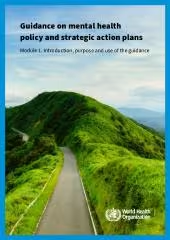
Image
Guidance on mental health policy and strategic action plans (WHO 2025)
Age group
Setting
Year
2025
Area
1.2
Description

Thiis series of guidance documents supports countries in developing, implementing, and evaluating comprehensive mental health policies and strategic action plans. It provides a structured framework grounded in evidence and best practice, covering key components such as governance, service delivery, financing, and monitoring, to help strengthen national mental health systems.

Brief description
WHO guidance for developing, implementing and evaluating national mental health policies and strategic plans.
Country
INTERNATIONAL
Keywords
governance, service delivery, financing, monitoring, strategic action plan
Resource Title
Guidance on mental health policy and strategic action plans (WHO 2025)
Source
European Commission
Topic
Mental health
Tools & Frameworks
Strategy
Language
EN
Relevant actions
Scope: EU
Use it to…
Align national action with current EU priorities and reinforce a whole-of-government approach.
Where to look in this resource
The whole document is relevant; its concrete commitments to align to are set out in the "Flagship initiatives", spanning promotion, prevention and early intervention, vulnerable groups, and the determinants of mental health.
Image
A Comprehensive Approach to Mental Health (European Commission 2023)
Age group
Setting
Year
2023
Area
1.2
Description

Outlines a holistic and cross-sectoral approach to mental health, recognising its links to social, economic, and environmental factors. It sets out strategic priorities and actions across prevention, care, and inclusion, aiming to strengthen mental health systems, reduce stigma, and improve access to support across Member States.

Brief description
EU strategy document setting out a cross-sectoral approach to mental health promotion, care and inclusion.
Country
EUROPE
Keywords
EU strategy, stigma reduction, inclusion, whole-of-government, cross-sectoral action
Resource Title
A Comprehensive Approach to Mental Health (European Commission 2023)
Source
WHO
Topic
CAH
Tools & Frameworks
Strategy
Language
EN
Relevant actions
Scope: WHO European Region
Use it to…
Connect child and adolescent mental health to broader regional health and wellbeing priorities.
Where to look in this resource
The whole strategy is relevant — it sets out the vision, priorities and strategic directions, including the mental health elements within its life-course, determinants-based approach.
Image
A healthy start for a healthy life: a strategy for child and adolescent health and well-being in the WHO European Region 2026–2030
Setting
Year
2020
Area
1.2
Description

Outlines a regional vision and priorities for improving the health and well-being of children and adolescents across the WHO European Region. It takes a life-course and systems-based approach, addressing key determinants of health—including mental health—and providing strategic directions to support countries in strengthening policies, services, and preventive actions.

Brief description
WHO regional strategy for improving child and adolescent health and wellbeing through a life-course approach.
Country
EUROPE
Keywords
life-course approach, regional strategy, determinants of health, systems-based, 2026-2030
Resource Title
A healthy start for a healthy life: a strategy for child and adolescent health and well-being in the WHO European Region 2026–2030