Toolkit guide
Source
European Commission
Topic
Digital determinants
Tools & Frameworks
EU policy framework
Language
EN
Use it to…
align national action on children's digital wellbeing with the emerging EU regulatory framework for online safety.
Where to look in this resource
The accompanying Communication ('An EU approach to online child safety') giveS the most accessible overview; the proposal itself sets out the age rules and safety-by-design obligations, and the Staff Working Document analyses expected impacts.
Area
1.2
Description

Adopted by the European Commission on 17 September 2026, the proposal sets a harmonised EU framework for children's online safety built on four pillars: delayed access to social media, safety by design, age assurance and parental responsibility, and strong enforcement. It would prohibit social media accounts under 13, allow parent-supervised accounts at 13–14 and independent accounts from 15, and require services such as social media, video platforms, online games, AI chatbots and app stores to avoid design features that drive excessive use. It is still a proposal and must be negotiated by the European Parliament and the Council.
Brief description
Proposed EU regulation setting common age rules and safety-by-design obligations for digital services used by children.
Country
EUROPE
Keywords
online safety, social media age limits, safety by design, age verification, parental tools, EU regulation, digital determinants
Resource Title
Proposal for EU KIDS Act - 'EU Keeping Internet Digital Spaces Accountable and Trustworthy' - Shaping Europe’s digital future (European Commission, 2026)
Source
European Commission
Topic
Digital determinants
Tools & Frameworks
Report
Language
EN
Use it to…
benchmark national data on adolescents' screen and social media use and build the evidence case for action on the digital determinants of mental health.
Where to look in this resource
Read the report as a whole — it covers screen time, social media use and self-reported mental and physical health symptoms (Action 1), and the role of age of first social media use, online content and parents (Action 2). Country-level results allow national benchmarking.
Area
1.1
Description

Conducted for the European Commission (DG SANTE) in spring 2026, the survey gathered responses from over 26,000 adolescents aged 13–18 and more than 12,700 parents across all 27 Member States. It provides comparable data on the prevalence, intensity and contexts of screen and social media use, and shows a consistent association between screen time and reported symptoms such as sleep problems, fatigue, concentration difficulties, stress and anxiety, with earlier social media use linked to heavier screen time. The findings describe statistical associations based on self-reported data rather than causal effects.

Brief description
EU-wide survey of adolescents and parents on screen and social media use and its links with mental and physical health.
Country
EUROPE
Keywords
screen time, social media, adolescents, parents, sleep, anxiety, Eurobarometer, EU27
Resource Title
European Commission. Impact of excessive screen time and social media on young people's mental health. Flash Eurobarometer 579
Source
WHO
Topic
Digital determinants
Tools & Frameworks
Policy Brief
Language
EN
Relevant actions
Layer 1
Use it to…
Inform policy responses to the growing influence of digital environments on young people’s mental health.
Where to look in this resource
The whole document is relevant in its entirety: it summarises the current evidence on the impact of digital environments on youth mental health and translates it into eight priority actions for policy responses.
Image
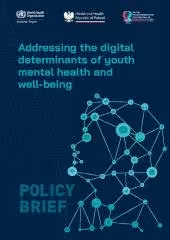
Addressing the digital determinants of youth mental health and well-being: policy brief (WHO EURO 2025)
Year
2025
Area
2.2
Description

Examines how digital environments influence youth mental health, including both risks and opportunities. It synthesises emerging evidence and provides policy recommendations to promote safer, healthier digital experiences for young people.

Brief description
Policy brief on how digital environments affect youth mental health and what policy responses are needed.
Country
EUROPE
Keywords
digital determinants, online risks & opportunities, policy recommendations, youth mental health
Resource Title
Addressing the digital determinants of youth mental health and well-being: policy brief (WHO EURO 2025)
Topic
Digital determinants
Tools & Frameworks
Policy Brief
Language
EN
Relevant actions
Actions 2 & 4
Use it to…
understand the digital determinants of mental health and the inequalities and rights issues they raise.
Where to look in this resource
A short, focused brief — read it in full. It covers digital risks and benefits and their mental-health implications (Action 2), and digital inequalities and the child-rights dimension — who is most exposed and least protected (Action 4).
Image
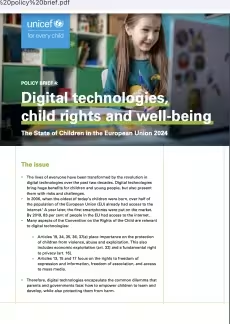
Digital technologies, child rights and well-being: The State of Children in the European Union 2024
Year
2024
Area
1.1
Description

Synthesises evidence across the European Union on how children engage with digital technologies, including patterns of access, use, benefits, and risks. It examines key issues such as digital inequalities, online safety, and the impact of digital environments on children’s development and well-being, including mental health. The brief highlights how social, economic, and structural factors shape children’s digital experiences and identifies key areas where policy action is needed to ensure that digital technologies support, rather than undermine, children’s rights and well-being.

Brief description
EU-focused synthesis of evidence on children’s access to, use of, and experiences with digital technologies, highlighting implications for mental health, well-being, and inequalities.
Country
EUROPE
Keywords
digital rights, online safety, digital inequalities, EU policy, child development
Resource Title
Digital technologies, child rights and well-being: The State of Children in the European Union 2024
Topic
Promising practice - scalable digital CBT, free/embedded in care, multilingual transfer.
Tools & Frameworks
Good practice
Language
EN
Use it to…
Use it to help identify, adapt, and apply effective solutions for accessible web-based self-help for mild-to-moderate depression.
Where to look in this resource
The whole document is relevant - it summarises the main characteristics of the practice.
Image
I Fight Depression
Area
2.2
Description

A web-based, guided self-help tool grounded in cognitive-behavioural therapy principles, with a dedicated section for young people. It is part of routine care in Germany (free of charge), translated into multiple languages and available across several European countries.

Brief description
Web-based CBT self-help tool for mild-to-moderate depression.
Country
Bulgaria, Estonia, Germany, Greece, Hungary, Ireland, Italy, Poland, Spain 
Keywords
digital CBT, cognitive-behavioural therapy, depression, self help
Resource Title
I Fight Depression
Topic
Promising practice - digital, peer-based, promotion/universal prevention.
Tools & Frameworks
Good practice
Language
EN
Use it to…
Use it to help identify, adapt, and apply effective solutions for digital peer-learning platforms for youth mental health.
Where to look in this resource
The whole document is relevant - it summarises the main characteristics of the practice.
Image
Peerlearning.net
Area
2.2
Description

An online peer-learning platform supporting mental health promotion and prevention among young people through digital resources and peer engagement.

Brief description
Digital peer-learning platform for mental health (Italy).
Country
Italy 
Keywords
peer-based, digital, promotion, universal prevention
Resource Title
Peerlearning.net
Topic
Promising practice - digital/game-based, anxiety-focused, scalable.
Tools & Frameworks
Good practice
Language
EN
Use it to…
Use it to help identify, adapt, and apply effective solutions for engaging digital self-help tools for childhood anxiety.
Where to look in this resource
The whole document is relevant - it summarises the main characteristics of the practice.
Image
Lumi Nova
Area
2.2
Description

A therapeutic mobile game (digital intervention) that helps children manage fears and anxiety using evidence-based techniques delivered through gameplay.

Brief description
Therapeutic mobile game for childhood anxiety (UK).
Country
UK 
Keywords
game-based, anxiety, digital, scalable, subclinical care
Resource Title
Lumi Nova
Topic
Innovative practice (*) - digital, research-stage, universal prevention.
Tools & Frameworks
Innovative practice
Language
EN
Use it to…
Use it to help identify, adapt, and apply effective solutions for innovative digital interventions in youth mental health.
Where to look in this resource
The whole document is relevant - it summarises the main characteristics of the practice.
Image
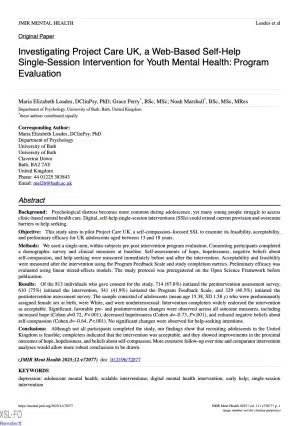
Project Care UK *
Area
2.2
Description

A digital mental health intervention for young people, documented in peer-reviewed research, addressing prevention/early support through an online format.

Brief description
Digital mental health intervention (UK).
Country
UK
Keywords
digital, research-stage, universal prevention, innovative practice
Resource Title
Project Care UK *
Topic
Innovative practice (*) - widely adopted multilingual digital tool; evaluation limited.
Tools & Frameworks
Innovative practice
Language
EN
Use it to…
Use it to help identify, adapt, and apply effective solutions for scalable digital self-help tools for young people.
Where to look in this resource
The whole document is relevant - it summarises the main characteristics of the practice.
Image
Nepanikar *
Area
2.2
Description

An app-based tool developed in the Czech Republic, designed primarily for young people, offering support across anxiety, eating disorders and crisis situations, plus courses and training on prevention and crisis intervention. It is available in 18 languages and adopted across several European countries.

Brief description
Mental health self-help app for young people (Czechia).
Country
Czechia, Germany, Estonia, Finland, France, Italia, Norway, Poland, Portugal, Slovakia, Slovenia 
Keywords
multilingual, digital tool, widely adopted, evaluation limited
Resource Title
Nepanikar *
Source
European Commission, 2023
Topic
Innovative practice (*) - digital MHPSS, migrant/refugee priority.
Tools & Frameworks
Innovative practice
Language
EN
Use it to…
Use it to help identify, adapt, and apply effective solutions for digital mental health and psychosocial support for migrant and refugee children.
Where to look in this resource
The whole document is relevant - it summarises the main characteristics of the practice.
Image
Here4You (Here4U) *
Area
2.2
Description

A digital, remote mental health and psychosocial support service for migrant and refugee children; identified as a good practice in a previous UNICEF report.

Brief description
Digital MHPSS service for migrant and refugee children (Italy).
Country
Italy 
Keywords
digital MHPSS, migrant & refugee, innovative practice
Resource Title
Here4You (Here4U) *