Toolkit guide
Source
JA ImplemMENTAL
Topic
Targeted mental health prevention
Tools & Frameworks
Handbook
Language
EN
Relevant actions
Action 3
Use it to…
draw on practical lessons from a European national programme that can be adapted in other contexts.
Where to look in this resource
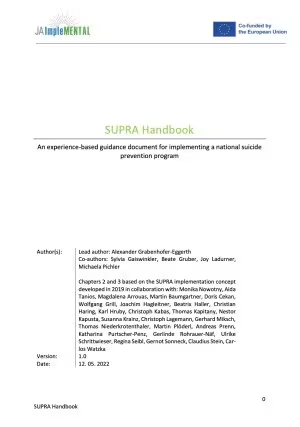
The SUPRA concept of implementation is structured around six “Columns” — Coordination and organisation; Support and treatment; Restriction of access to means; Awareness and knowledge; Embedment in prevention and health promotion; and Quality assurance and expertise — set out with a stepwise implementation approach and monitoring and evaluation guidance.
Image
SUPRA Handbook: An experience-based guidance document for implementing a national suicide prevention program (JA ImpleMENTAL 2022)

Age group
Setting
Area
3.1
Description

A practical guide based on Austria’s experience implementing its national suicide prevention programme, designed to help other countries develop similar strategies. It outlines a structured approach aligned with WHO guidance, covering how to set priorities, coordinate stakeholders, and translate strategy into actionable steps. The handbook also highlights key lessons on governance, implementation, and evaluation, providing adaptable tools and examples to support effective, evidence-based suicide prevention efforts

Brief description
Handbook to guide other countries in developing or scaling up their own national or regional suicide prevention strategies.
Country
EUROPE
Keywords
national suicide prevention programme, stakeholder coordination, governance, adaptable lessons
Resource Title
SUPRA Handbook: An experience-based guidance document for implementing a national suicide prevention program (JA ImpleMENTAL 2022)
Source
WHO
Topic
Targeted mental health prevention
Tools & Frameworks
Implementation Guide
Language
EN
Relevant actions
Action 3
Use it to…
structure national suicide-prevention planning, coordination and implementation.
Where to look in this resource
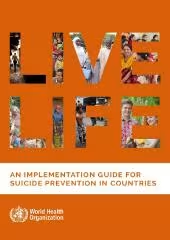
Part A sets out the LIVE LIFE core pillars (multisectoral collaboration; awareness-raising and advocacy; financing; surveillance; and monitoring and evaluation) — the foundations for coordinated implementation; Part B sets out the four key interventions (limit access to means; responsible media reporting; foster socio-emotional life skills in adolescents; and early identification, assessment, management and follow-up).
Image
LIVE LIFE: An implementation guide for suicide prevention in countries (WHO 2021)
Age group
Setting
Year
2021
Area
3.1
Description

 A practical implementation guide that sets out a simple, evidence-based framework to help countries initiate or strengthen suicide prevention efforts. It focuses on four key interventions—such as limiting access to means, promoting responsible media reporting, building life skills in young people, and improving early identification and care—supported by cross-cutting pillars like governance, collaboration, and monitoring. Designed for both national and local stakeholders, the guide provides a structured starting point for developing coordinated, multi-sector suicide prevention strategies that can be adapted to different contexts.

Brief description
WHO implementation guide for developing or strengthening national suicide prevention strategies.
Country
INTERNATIONAL
Keywords
life skills, early identification, governance, suicide
Resource Title
LIVE LIFE: An implementation guide for suicide prevention in countries (WHO 2021)
Source
WHO
Topic
Guaranteeing access to early intervention and mental health services and support
Tools & Frameworks
Guidelines
Language
EN
Relevant actions
Actions 2 & 3
Use it to…
organise coordinated, multi-level service delivery across sectors
Where to look in this resource
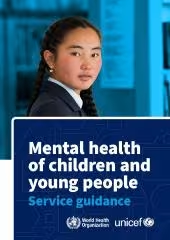
The “Strengthening systems” chapter (standards, governance, family and youth participation, financing, workforce and information systems) is the most relevant for cross-sector coordination and the enabling conditions; the “Designing and delivering services” chapter covers how services are organised and integrated across the health and non-health sectors.
Image
Mental health of children and young people: service guidance (WHO 2025)
Setting
Year
2025
Area
3.1
Description

Outlines key principles and standards for designing and delivering effective mental health services for children and young people. It focuses on service organisation, accessibility, quality of care, and integration across sectors, helping countries strengthen systems to better meet the needs of young populations.

Brief description
Guidance on organising accessible, high-quality mental health services for children and young people.
Country
INTERNATIONAL
Keywords
service organisation, accessibility, quality of care, integration, standards
Resource Title
Mental health of children and young people: service guidance (WHO 2025)
Source
WHO, UNICEF
Topic
Guaranteeing access to early intervention and mental health services and support
Tools & Frameworks
Toolkit
Language
EN
Relevant actions
Layers 1 & 2
Use it to…
translate global recommendations into practical steps for implementation, adaptation and scale-up.
Where to look in this resource
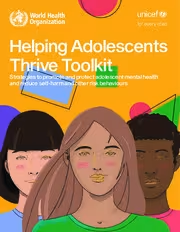
The toolkit is organised around four Strategies — “Policies and laws”, “Environments”, “Caregivers” and “Psychosocial interventions” — each with implementation guidance and examples. The “Policies and laws” and “Environments” strategies speak to enabling environments (Layer 1); the “Environments”, “Caregivers” and “Psychosocial interventions” strategies to universal prevention (Layer 2).
Image
Helping Adolescent Thrive Toolkit (WHO and UNICEF 2020)
Setting
Year
2020
Area
2.2
Description

Practical, evidence-based guidance for implementing mental health promotion and prevention interventions for adolescents. It translates global recommendations into actionable tools, supporting practitioners and policymakers to design, deliver, and scale interventions that strengthen adolescents’ emotional well-being and resilience.

Brief description
Practical toolkit for implementing adolescent mental health promotion and prevention interventions.
Country
INTERNATIONAL
Keywords
practical toolkit, resilience, scale-up, practitioners, actionable tools
Resource Title
Helping Adolescent Thrive Toolkit (WHO and UNICEF 2020)
Source
WHO
Topic
Guaranteeing access to early intervention and mental health services and support
Tools & Frameworks
Guidelines
Language
EN
Relevant actions
Layers 2 & 3
Use it to…
Clarify how prevention and promotion link to early intervention and effective service organisation.
Where to look in this resource
The “Designing and delivering services” chapter (principles for service delivery; integration in general health services; community mental health services; services beyond the health sector; and digital interventions) and the “Strengthening systems” chapter (standards, governance, family and youth participation, financing, workforce and information systems) are the practical core. Note: this is about organising and delivering mental health care, which sits at targeted prevention and the care layers above.
Image
Mental health of children and young people: service guidance (WHO 2025)
Setting
Year
2025
Area
2.2
Description

Outlines key principles and standards for designing and delivering effective mental health services for children and young people. It focuses on service organisation, accessibility, quality of care, and integration across sectors, helping countries strengthen systems to better meet the needs of young populations.

Brief description
Guidance on organising accessible, high-quality mental health services for children and young people.
Country
INTERNATIONAL
Keywords
service organisation, accessibility, quality of care, integration, standards
Resource Title
Mental health of children and young people: service guidance (WHO 2025)
Source
WHO
Topic
Targeted mental health prevention
Tools & Frameworks
Implementation Guide
Language
EN
Relevant actions
Layer 3
Use it to…
Provide a structured model for national suicide prevention planning, coordination and implementation.
Where to look in this resource
The whole document is relevant, as it lays out a structured model - covering planning and coordination and implementation (four key interventions and six cross-cutting pillars) - for countries to build a national suicide prevention approach.
Image
LIVE LIFE: An implementation guide for suicide prevention in countries (WHO 2021)
Age group
Setting
Year
2021
Area
2.2
Description

A practical implementation guide that sets out a simple, evidence-based framework to help countries initiate or strengthen suicide prevention efforts. It focuses on four key interventions—such as limiting access to means, promoting responsible media reporting, building life skills in young people, and improving early identification and care—supported by cross-cutting pillars like governance, collaboration, and monitoring. Designed for both national and local stakeholders, the guide provides a structured starting point for developing coordinated, multi-sector suicide prevention strategies that can be adapted to different contexts.

Brief description
WHO implementation guide for developing or strengthening national suicide prevention strategies.
Country
INTERNATIONAL
Keywords
life skills, early identification, governance, suicide
Resource Title
LIVE LIFE: An implementation guide for suicide prevention in countries (WHO 2021)
Topic
Targeted mental health prevention
Tools & Frameworks
Handbook
Language
EN
Relevant actions
Layer 3
Use it to…
design or scale up a national or regional suicide prevention strategy, drawing on a concrete, field-tested set of goals and actions rather than starting from theory alone.
Where to look in this resource
The most useful part is the detailed presentation of the SUPRA implementation model — its six strategic goals, 18 operational goals, and 70 concrete actions, organized into the "column model" — with each action tagged by prevention type (universal, selective, or indicated).
A secondary, practically-oriented section is the "starting package": a prioritized set of core actions from each of the six columns, designed to be implementable within two years with manageable effort, taking into account the federal/regional division of responsibilities. This is especially useful for a policymaker who needs a realistic, sequenced entry point rather than the full programme all at once.
Image
SUPRA Handbook: An experience-based guidance document for implementing a national suicide prevention program (JA ImpleMENTAL 2022)
Setting
Area
2.2
Description

A practical guide based on Austria’s experience implementing its national suicide prevention programme, designed to help other countries develop similar strategies. It outlines a structured approach aligned with WHO guidance, covering how to set priorities, coordinate stakeholders, and translate strategy into actionable steps. The handbook also highlights key lessons on governance, implementation, and evaluation, providing adaptable tools and examples to support effective, evidence-based suicide prevention efforts

Brief description
Handbook to guide other countries in developing or scaling up their own national or regional suicide prevention strategies.
Resource Title
SUPRA Handbook: An experience-based guidance document for implementing a national suicide prevention program (JA ImpleMENTAL 2022)
Source
UNICEF
Topic
youth participation
Tools & Frameworks
Framework
Language
EN
Relevant actions
Action 4
Use it to…
Take a structured, evidence-informed approach to integrating adolescent perspectives into policy design, implementation and evaluation.
Where to look in this resource
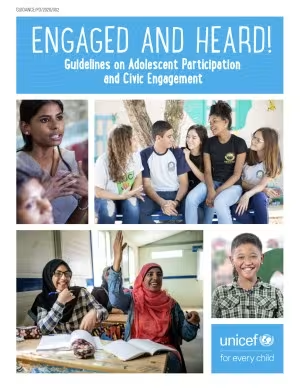
The whole guide is relevant to embedding participation. Its practical core includes the essential features of meaningful participation (the "space, voice, audience and influence" framework), the modes of participation (consultative, collaborative and adolescent-led), and the sections on applying a rights-based approach and ensuring equity and inclusion — supported by tools for monitoring, evaluation and implementation across sectors.
Image
Engaged and Heard (UNICEF 2020)
Setting
Year
2020
Area
2.3
Description

Detailed guidance on the principles, strategies, and practical steps needed to support adolescent participation across sectors and contexts. Grounded in a rights-based approach aligned with the UN Convention on the Rights of the Child, it defines participation as adolescents’ ability to form, express, and influence decisions on issues affecting them . The guidelines outline key concepts such as inclusive and equitable participation, the importance of “space, voice, audience and influence” (illustrated in the framework on page 12), and different modes of engagement ranging from consultative to adolescent-led processes. It also presents a systems-oriented approach, including policy advocacy, capacity-building, and the creation of sustainable platforms for engagement, supported by tools for monitoring, evaluation, and implementation across sectors like health, education, and child protection.

Brief description
A comprehensive framework for enabling meaningful, rights-based participation of adolescents in decision-making processes that affect their lives.
Country
INTERNATIONAL
Keywords
adolescent participation, rights-based, space voice audience influence, co-design, monitoring & evaluation
Resource Title
Engaged and Heard (UNICEF 2020)
Source
OECD
Topic
Guaranteeing access to early intervention and mental health services and support
Tools & Frameworks
Report
Language
EN
Relevant actions
Layers 1, 2 & 3
Use it to…
bring together cost-effective public health approaches and the policy levers needed to support them.
Where to look in this resource
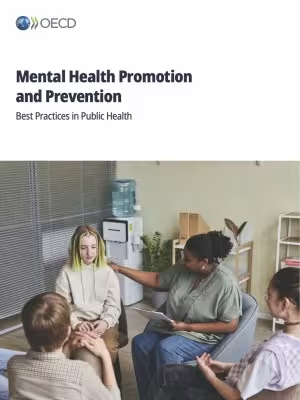
The “Assessment and recommendations” chapter sets out the cross-cutting findings, cost-effectiveness and policy levers. The best-practice chapters most relevant to children, adolescents and young people are Zippy’s Friends (school-based social-emotional learning), Icehearts (long-term mentoring for children at higher risk), @ease (youth walk-in / low-threshold early support), “This is me” (youth mental health), Next Stop: Mum (perinatal depression screening) and SUPRA (suicide prevention, Austria).
Image
Mental Health Promotion and Prevention: Best Practices in Public Health (OECD 2025)
Age group
Setting
Year
2025
Area
2.2
Description

Synthesises international evidence on effective public health approaches to mental health promotion and prevention. The report highlights cost-effective interventions, policy levers, and implementation strategies, supporting governments in scaling up initiatives that improve population mental health and reduce long-term system burdens.

Brief description
OECD report on cost-effective public health approaches to mental health promotion and prevention.
Country
EUROPE
Keywords
cost-effectiveness, policy levers, scale-up, public health, mental health, promotion and prevention
Resource Title
Mental Health Promotion and Prevention: Best Practices in Public Health (OECD 2025)
Topic
Promising practice - multi-systemic, evidence-based; spans subclinical and clinical care.
Tools & Frameworks
Good practice
Language
EN
Use it to…
Use it to help identify, adapt, and apply effective solutions for family-based therapy for adolescent substance use and behavioural problems.
Where to look in this resource
The whole document is relevant - it summarises the main characteristics of the practice.
Image
37_MDFT
Area
2.2
Description

A comprehensive, family-based treatment for adolescents experiencing substance use, behavioural and related mental health difficulties, working across the young person's family, peer, school and community systems. It is implemented in several European countries.

Brief description
Family-based therapy for adolescents with substance use and behavioural problems.
Country
Estonia, Belgium, Germany, France, the Netherlands 
Keywords
multi-systemic therapy, subclinical, clinical, school, community, peers
Resource Title
Multi-dimensional Family Therapy (MDFT)