Toolkit guide
Source
JA ImplemMENTAL
Topic
Targeted mental health prevention
Tools & Frameworks
Handbook
Language
EN
Relevant actions
Action 3
Use it to…
draw on practical lessons from a European national programme that can be adapted in other contexts.
Where to look in this resource
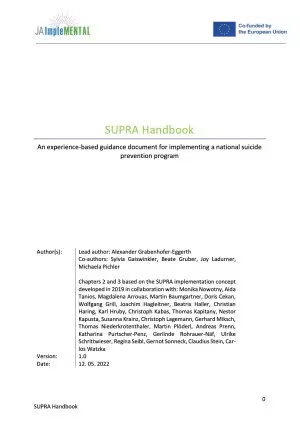
The SUPRA concept of implementation is structured around six “Columns” — Coordination and organisation; Support and treatment; Restriction of access to means; Awareness and knowledge; Embedment in prevention and health promotion; and Quality assurance and expertise — set out with a stepwise implementation approach and monitoring and evaluation guidance.
Image
SUPRA Handbook: An experience-based guidance document for implementing a national suicide prevention program (JA ImpleMENTAL 2022)
Age group
Setting
Area
3.1
Description

A practical guide based on Austria’s experience implementing its national suicide prevention programme, designed to help other countries develop similar strategies. It outlines a structured approach aligned with WHO guidance, covering how to set priorities, coordinate stakeholders, and translate strategy into actionable steps. The handbook also highlights key lessons on governance, implementation, and evaluation, providing adaptable tools and examples to support effective, evidence-based suicide prevention efforts

Brief description
Handbook to guide other countries in developing or scaling up their own national or regional suicide prevention strategies.
Country
EUROPE
Keywords
national suicide prevention programme, stakeholder coordination, governance, adaptable lessons
Resource Title
SUPRA Handbook: An experience-based guidance document for implementing a national suicide prevention program (JA ImpleMENTAL 2022)
Source
WHO
Topic
Targeted mental health prevention
Tools & Frameworks
Implementation Guide
Language
EN
Relevant actions
Action 3
Use it to…
structure national suicide-prevention planning, coordination and implementation.
Where to look in this resource
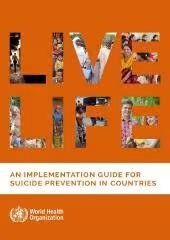
Part A sets out the LIVE LIFE core pillars (multisectoral collaboration; awareness-raising and advocacy; financing; surveillance; and monitoring and evaluation) — the foundations for coordinated implementation; Part B sets out the four key interventions (limit access to means; responsible media reporting; foster socio-emotional life skills in adolescents; and early identification, assessment, management and follow-up).
Image
LIVE LIFE: An implementation guide for suicide prevention in countries (WHO 2021)
Age group
Setting
Year
2021
Area
3.1
Description

 A practical implementation guide that sets out a simple, evidence-based framework to help countries initiate or strengthen suicide prevention efforts. It focuses on four key interventions—such as limiting access to means, promoting responsible media reporting, building life skills in young people, and improving early identification and care—supported by cross-cutting pillars like governance, collaboration, and monitoring. Designed for both national and local stakeholders, the guide provides a structured starting point for developing coordinated, multi-sector suicide prevention strategies that can be adapted to different contexts.

Brief description
WHO implementation guide for developing or strengthening national suicide prevention strategies.
Country
INTERNATIONAL
Keywords
life skills, early identification, governance, suicide
Resource Title
LIVE LIFE: An implementation guide for suicide prevention in countries (WHO 2021)
Source
UNICEF
Topic
PHC system strengtening
Tools & Frameworks
Framework
Language
EN
Relevant actions
Actions 2 & 3
Use it to…
Support integration of mental health promotion and early support into primary health care and routine child services.
Where to look in this resource
The framework is organised around 14 “levers” in two groups — Core strategic levers (political commitment and leadership; governance and policy frameworks; funding and allocation of resources; engagement of communities and stakeholders) and Operational levers (models of care; workforce; physical infrastructure; quality; monitoring and evaluation; and others). The governance and stakeholder-engagement levers speak to cross-sector coordination (Action 2); the funding, models-of-care, workforce and infrastructure levers to the enabling conditions (Action 3).
Image
Operational Framework for Primary Health Care (UNICEF 2020)
Age group
Setting
Year
2020
Area
3.1
Description

Outlines strategic and operational levers that countries can use to implement PHC effectively. The framework includes a measurement system to track progress and performance in PHC, ensuring that health systems can adapt and respond to changing needs and challenges.

Brief description
Framework outlining how countries can strengthen primary health care systems and track their performance.
Country
INTERNATIONAL
Keywords
Primary Healthcare, measurement system, integration, performance tracking, routine child services
Resource Title
Operational Framework for Primary Health Care (UNICEF 2020)
Source
WHO
Topic
Mental healh
Tools & Frameworks
Database
Language
EN
Relevant actions
Actions 1 & 2
Use it to…
benchmark system-level indicators on governance, workforce, financing and service availability.
Where to look in this resource
The data on governance, financing, workforce and service availability and coverage provide the standardised system-level indicators to benchmark and track over time - alongside your country profile.
Image
Mental Health Atlas 2024 (WHO 2025)
Age group
Setting
Year
2013
Area
3.2
Description

Compiles global data on mental health systems, including policies, services, workforce, and financing. It enables countries to track progress, identify gaps in care, and benchmark against international targets, supporting efforts to strengthen mental health systems and improve access to services. Country level data is presented in the country profiles available on the website.

Brief description
Global WHO database tracking countries’ mental health policies, services, workforce and financing.
Country
INTERNATIONAL
Keywords
Mental Health Atlas, country profiles, workforce, financing, benchmarking
Resource Title
Mental Health Atlas 2024 (WHO 2025)
Source
WHO
Topic
Mental healh
Tools & Frameworks
Database
Language
EN
Relevant actions
Action 3
Use it to…
assess system capacity, service coverage, workforce and financing gaps against international benchmarks.
Where to look in this resource
The “Governance of mental health systems”, “Mental health financing and workforce” and “Mental health services” sections (including service coverage) - plus your country profile on the website
Image
Mental Health Atlas 2024 (WHO 2025)
Age group
Setting
Year
2024
Area
1.1
Description

Compiles global data on mental health systems, including policies, services, workforce, and financing. It enables countries to track progress, identify gaps in care, and benchmark against international targets, supporting efforts to strengthen mental health systems and improve access to services. Country level data is presented in the country profiles available on the website.

Brief description
Global WHO database tracking countries’ mental health policies, services, workforce and financing.
Country
INTERNATIONAL
Keywords
Mental Health Atlas, country profiles, workforce, financing, benchmarking
Resource Title
Mental Health Atlas 2024 (WHO 2025)
Source
WHO
Topic
mental health
Tools & Frameworks
Guidelines
Language
EN
Relevant actions
Scope: Global
Use it to…
Translate evidence into a coherent national policy and strategic planning framework.
Where to look in this resource
This file is Module 1 of a five-module WHO series — it sets out the approach and rationale (new directions for reform, the human-rights framework, and the social and structural determinants of mental health). The practical reform areas and the step-by-step process for developing, implementing and evaluating a policy or action plan are in Modules 2 and 3 of the series.
Image
Guidance on mental health policy and strategic action plans (WHO 2025)
Age group
Setting
Year
2025
Area
1.2
Description

Thiis series of guidance documents supports countries in developing, implementing, and evaluating comprehensive mental health policies and strategic action plans. It provides a structured framework grounded in evidence and best practice, covering key components such as governance, service delivery, financing, and monitoring, to help strengthen national mental health systems.

Brief description
WHO guidance for developing, implementing and evaluating national mental health policies and strategic plans.
Country
INTERNATIONAL
Keywords
governance, service delivery, financing, monitoring, strategic action plan
Resource Title
Guidance on mental health policy and strategic action plans (WHO 2025)
Source
European Commission
Topic
Mental health
Tools & Frameworks
Strategy
Language
EN
Relevant actions
Scope: EU
Use it to…
Align national action with current EU priorities and reinforce a whole-of-government approach.
Where to look in this resource
The whole document is relevant; its concrete commitments to align to are set out in the "Flagship initiatives", spanning promotion, prevention and early intervention, vulnerable groups, and the determinants of mental health.
Image
A Comprehensive Approach to Mental Health (European Commission 2023)
Age group
Setting
Year
2023
Area
1.2
Description

Outlines a holistic and cross-sectoral approach to mental health, recognising its links to social, economic, and environmental factors. It sets out strategic priorities and actions across prevention, care, and inclusion, aiming to strengthen mental health systems, reduce stigma, and improve access to support across Member States.

Brief description
EU strategy document setting out a cross-sectoral approach to mental health promotion, care and inclusion.
Country
EUROPE
Keywords
EU strategy, stigma reduction, inclusion, whole-of-government, cross-sectoral action
Resource Title
A Comprehensive Approach to Mental Health (European Commission 2023)
Source
UNICEF
Topic
PHC system strengtening
Tools & Frameworks
Framework
Language
EN
Relevant actions
Layer 2
Use it to…
Support integration of mental health promotion and early support into primary health care and routine child services.
Where to look in this resource
The most relevant sections are the "models of care" lever (section 3.1) , which addresses integrating services around population needs, and the core strategic levers (leadership, governance, financing, community engagement) that underpin any such integration effort (secton 2) .
Image
Operational Framework for Primary Health Care (UNICEF 2020)
Age group
Setting
Year
2020
Area
2.2
Description

Outlines strategic and operational levers that countries can use to implement PHC effectively. The framework includes a measurement system to track progress and performance in PHC, ensuring that health systems can adapt and respond to changing needs and challenges.

Brief description
Framework outlining how countries can strengthen primary health care systems and track their performance.
Country
INTERNATIONAL
Keywords
Primary Healthcare, measurement system, integration, performance tracking, routine child services
Resource Title
Operational Framework for Primary Health Care (UNICEF 2020)
Source
WHO
Topic
Targeted mental health prevention
Tools & Frameworks
Implementation Guide
Language
EN
Relevant actions
Layer 3
Use it to…
Provide a structured model for national suicide prevention planning, coordination and implementation.
Where to look in this resource
The whole document is relevant, as it lays out a structured model - covering planning and coordination and implementation (four key interventions and six cross-cutting pillars) - for countries to build a national suicide prevention approach.
Image
LIVE LIFE: An implementation guide for suicide prevention in countries (WHO 2021)
Age group
Setting
Year
2021
Area
2.2
Description

A practical implementation guide that sets out a simple, evidence-based framework to help countries initiate or strengthen suicide prevention efforts. It focuses on four key interventions—such as limiting access to means, promoting responsible media reporting, building life skills in young people, and improving early identification and care—supported by cross-cutting pillars like governance, collaboration, and monitoring. Designed for both national and local stakeholders, the guide provides a structured starting point for developing coordinated, multi-sector suicide prevention strategies that can be adapted to different contexts.

Brief description
WHO implementation guide for developing or strengthening national suicide prevention strategies.
Country
INTERNATIONAL
Keywords
life skills, early identification, governance, suicide
Resource Title
LIVE LIFE: An implementation guide for suicide prevention in countries (WHO 2021)
Source
WHO
Topic
stigma
Tools & Frameworks
Toolkit
Language
EN
Relevant actions
Layer 1
Use it to…
Support the design of scalable, system-level strategies to reduce stigma and discrimination, a key barrier to access, equity, and effectiveness in mental health systems.
Where to look in this resource
The whole document is relevant, as it sets out a four-step, evidence-based process — built on lived-experience leadership, social contact, and inclusive collaboration — for planning, delivering, and evaluating anti-stigma initiatives across health, workplace, school, and community settings.
Image
Mosaic toolkit to end stigma and discrimination in mental health

Age group
Setting
Area
2.2
Description

A structured and evidence-informed approach to reducing stigma and discrimination associated with mental health conditions. It is grounded in three core principles—leadership by people with lived experience, social contact, and inclusive collaboration—and translates these into a practical four-step process for designing, implementing, and scaling anti-stigma interventions. The toolkit combines conceptual guidance with actionable steps and real-world case studies, enabling adaptation across different policy, service, and community contexts. It also highlights the systemic nature of stigma, including its impact on access to care, social inclusion, and life opportunities, and emphasises the role of coordinated, multisectoral action in addressing these challenge

Brief description
Provides practical, evidence-based guidance for designing and implementing interventions to reduce stigma and discrimination in mental health.
Country
INTERNATIONAL
Keywords
stigma, discrimination, lived experience leadership, social contact, four-step process
Resource Title
Mosaic toolkit to end stigma and discrimination in mental health